
How to know when it’s time to test, recharge, or replace these critical tools
Fire extinguishers are one of those things that you don’t think about until you need one—but when you do need one, it absolutely has to work. A functioning extinguisher can make all the difference between a small, controllable fire and a major disaster. That’s why staying on top of inspection, testing, and replacement is so important for any organization.
But for larger businesses with numerous buildings spread over multiple locations, fire extinguisher maintenance can quickly become complex. Different extinguisher types have different service lives, inspection intervals, and testing requirements, and those requirements are shaped by a mix of national standards and local enforcement.
In this guide, we’ll cover the regulations that govern fire extinguisher maintenance, explain inspection and service requirements by extinguisher type, and clarify when routine checks can be handled in-house and when it’s time to call in a professional.
Who regulates fire extinguisher maintenance?
Who regulates your fire extinguishers depends on where you are, because compliance is ultimately enforced at the local level. Fire marshals, insurance companies, and other Authorities Having Jurisdiction (AHJs) are responsible for inspections and enforcement, and their requirements can vary by state, city, and even building type. That said, most local regulations are based on NFPA standards, particularly NFPA 10, which provides the national framework for how fire extinguishers are selected, installed, inspected, maintained, and tested.
In the workplace, OSHA plays an important role as well. OSHA requires employers to provide and maintain portable fire extinguishers and explicitly references nationally recognized consensus standards—most commonly NFPA—when determining whether an employer is in compliance. In practice, meeting NFPA 10 requirements is the most reliable way to satisfy OSHA expectations and pass local fire inspections.
The result is a layered system:
- NFPA sets the standards
- OSHA recognizes and enforces them in workplace settings
- Local fire authorities apply and enforce those rules on the ground
For businesses operating across multiple locations, understanding this relationship is critical, since enforcement details and interpretations can vary from one jurisdiction to the next.
Types of extinguishers and their inspection requirements
Not all fire extinguishers are created equal, because not all fires are equal. The NFPA identifies 5 classes of fire based on the type of fuel involved. They are:
- Class A: Fires involving ordinary materials such as wood, paper, cloth.
- Class B: Fires involving flammable liquids or gases, such as gasoline, oil, solvents, and grease.
- Class C: Fires involving electrical equipment such as wiring, panels, motors, and appliances.
- Class D: Fires involving combustible metals like magnesium, titanium, sodium, or lithium.
- Class K: Fires involving cooking oils and fats, typically found in commercial kitchens.
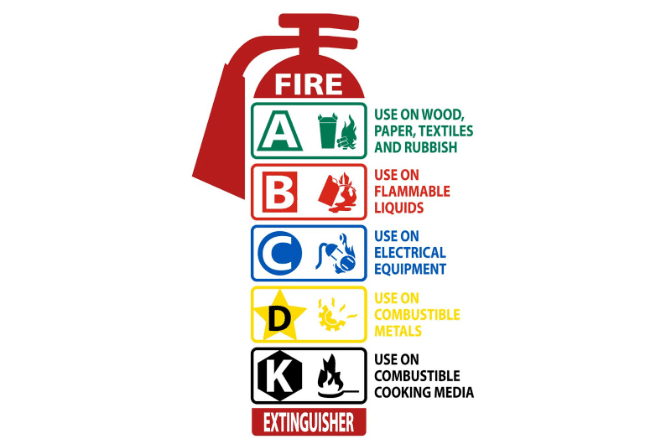
Different extinguishing agents are required for different classes of fire. The type of extinguisher and the class of fire that it is for are clearly stated on the extinguisher’s label. Below is an overview of some of the common types of fire extinguishers and their inspection requirements:
| Extinguisher type | Fire classes | Common use environments | Owner-Required Inspection | Professional maintenance | Internal maintenance | Hydrostatic testing |
| Rechargeable Stored Pressure Type Dry Chemical | A, B, C | Offices, warehouses, retail spaces, and light industrial | Monthly | Annually | Every 6 years (Except Nevada, which requires annual internal maintenance) | Every 12 years |
| Disposable Stored Pressure Type Dry Chemical | A, B, C | Offices, warehouses, retail spaces, and light industrial | A, B, C / B, C | n/a | n/a | n/a |
| Carteridge-Operated Dry Chemical | A, B, C / B,C | Heavy industrial facilities, manufacturing plants, fuel storage areas, maintenance shops | Monthly | Annually | Annually | Every 12 years |
| CO₂ (carbon dioxide) | B, C | Server rooms, electrical rooms, mechanical spaces | Monthly | Annually | Every 5 years | Every 5 years |
| Class K wet chemical | K | Commercial kitchens, near cooking equipment | Monthly | Inspected annually | Every 5 years | Every 5 years |
| Water or foam | A | Areas with ordinary combustibles and no electrical or flammable liquid hazards | Monthly | Annually | Annually for loaded stream foam, every 5yrs for water. d | Every 5 years |
| Clean Agent (Halogenated Agent) | B, C | Data centers, server rooms, telecommunications rooms, control rooms, medical imaging areas, clean rooms | Monthly | Annually | Every 6 years | Every 12 years |
| Wheeled Type (ABC, BC, PK, CO₂) | A, B, C / B, C / D (PK) depending on agent | Aircraft hangars, refineries, fuel storage/dispensing areas, warehouses, loading docks, industrial plants, large maintenance facilities | Monthly | Annually | Dry chemical (ABC/BC/PK): Every 6 years CO₂: Every 5 years | Dry chemical: Every 12 years CO₂: Every 5 years |
It’s important to note that even brand-new fire extinguishers require inspection after installation. Also, the service life and inspection schedule begin when the extinguisher is placed in service, not when it is manufactured or purchased.
How do you inspect fire extinguishers?
Fire extinguisher inspections fall into two categories: routine visual inspections and formal maintenance inspections.
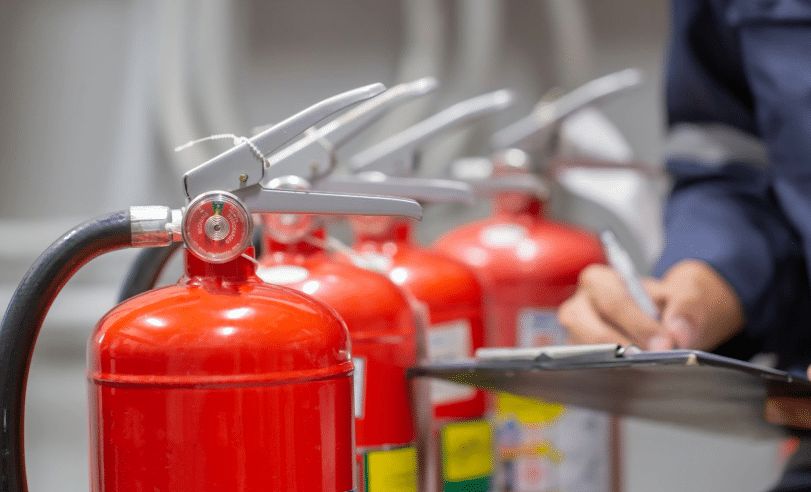
Monthly visual inspections
These checks can typically be performed by trained staff or by electronic monitoring and should be documented. A basic inspection includes verifying that:
- The extinguisher is in its designated location and clearly visible
- Access to the extinguisher is unobstructed
- The pressure gauge is in the operable range
- Fullness by weighing or hefting
- The pin and tamper seal are intact
- There is no visible damage, corrosion, or leakage
- The inspection tag or record is up to date
Even if you can perform monthly inspections yourself, many organizations–especially those with multiple locations–choose to outsource all inspections to reduce risk, ensure consistency, and simplify compliance.
Annual maintenance and testing
On top of regular monthly visual inspections, there are other, more in-depth tests that have to be done by a certified professional. These inspections go beyond what can be seen externally and ensure the extinguisher will operate correctly under pressure. They include:
- Annual inspections: Check the extinguisher’s external condition, weight, pressure, accessibility, and labeling.
- Internal maintenance: Open the extinguisher to inspect, clean, and replace internal parts and recharge the agent.
- Hydrostatic testing: Test the cylinder using water pressure to ensure it can safely hold its rated charge.
What to do when an extinguisher fails inspection?
The point of inspecting fire extinguishers is to ensure they’re ready when you need them. An extinguisher that fails inspection should be removed from service immediately. The next steps–whether it is repaired, recharged, or replaced—depend on the issue and the extinguisher type.
Some examples include:
- Low pressure or partial discharge
Rechargeable extinguishers can often be recharged by a certified technician. After recharging, they must be re-inspected and properly tagged before being returned to service. - Physical damage, corrosion, or missing parts
These extinguishers are typically removed from service and replaced. - Failed hydrostatic test or exceeded service life
Extinguishers that fail pressure testing or exceed their maximum service life must be permanently removed and replaced.
It’s also important to note that when replacing extinguishers, businesses must ensure the new units meet current code requirements, not just replicate what was previously installed. This is especially critical after renovations, occupancy changes, or expansions to maintain both safety and regulatory compliance.
When in doubt, call a professional
Fire safety is not something to take lightly. While a small business with a handful of extinguishers may be able to manage basic inspections internally, complexity increases rapidly as facilities, jurisdictions, and extinguisher types multiply.
If you have any doubts about the condition of your fire extinguishers—or any part of your fire suppression system—working with a professional can reduce risk, improve consistency, and ensure compliance.
Summit Fire & Security is a subsidiary of Summit Companies, the nation’s most-trusted fire and life safety company with an expert team of 2700+ technicians in over 100 locations across the country. If you’re looking for a partner to manage fire extinguisher inspections and fire protection for your organization, find a Summit Fire & Security team near you.