In honor of Women in Construction Week (March 1-7, 2026), we spoke with women currently working as system inspectors with Summit Fire & Security to learn more about their career paths in fire and life safety, the support that helped shape their journeys, and what it’s like working in this essential field.
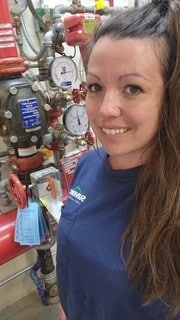
Nikki Wahl is an Inspector with Summit Fire & Security in Houston, Texas, and is the lead of her branch’s hospital inspection team. Nikki is fully licensed in alarm, sprinkler, backflow and extinguishers,
“Nikki Wahl has been a leader for the Houston inspection team as a multi-licensed inspector,” shares Nathan Whipple, District Manager with Summit Fire & Security, and Nikki’s manager. “Her attention to detail, focus on customer satisfaction and thoroughness in the field set her apart as an example of a well-rounded inspector.
“Customers love Nikki because they know their inspections will be done correctly and that they will be communicated with well,” Nathan continues. “Nikki is heavily relied on to lead our hospital inspection teams, has also been involved in training many other inspectors and has willingly shared her knowledge to improve the inspection team in Houston. Summit is fortunate to have Nikki as part of our family!”
Read on as Nikki shares her journey into the fire and life safety industry.
How did you become involved in fire protection?
When I got started in the field I came into the company taking the 2-year RMEI inspection trainee course. During the 2 years, I started out on the alarm and sprinkler service side my first year, give or take. Once I was assigned my own foreman, I then went to the sprinkler inspections side, where I learned sprinkler and backflow inspections and repairs. I took full advantage of being on the inspections side and took every opportunity to learn everything I could from my foreman.
I later had another opportunity to work with another foreman for a year, who had the alarm and suppression licenses. He also took care of the hospital inspections and taught me all I know in the Healthcare field. The documentation for the Healthcare is very tedious, which really set me up for success in the long run for inspections. I really got to learn the ropes and couldn’t be more grateful for each of my foreman that had a part in my training. Having about 2.5 years of training really set me up for success once I got fully licensed and became my own foreman.
Performing inspections for hospitals, how does it differ from inspections for other industries?
It’s a lot more strenuous because you must deal with Joint Commission. All documentation must be on point because if we make a mistake and Joint Commission discovers it, the hospital can be fined for our mistakes.
And at the end of the day, if there is a large mistake made by the fire protection team, the hospital director can lose their job, and the hospital may lose their annual funding. So, the hospitals are more demanding and attention to detail is essential. Everything needs to be documented accurately with a time stamp and a reference for all work completed.
Do you find the fire protection industry to be a high-pressure job?
It can be stressful. For instance, if you don’t have the right people with you, it can be very frustrating. But if you have a good crew, it’s a breeze for me. You get in your groove, and you just do your thing.
You must strive to be your best working with hospitals. I’ve been fortunate in my position because I’ve had other hospitals approach me through referrals from other hospitals. They want me as their inspector. I do feel the pressure, but at the end of the day, I feel accomplished.
What do you enjoy about the fire and life safety industry?
I like the fact that you’re going to a different place all the time. You’re not going to the same place or always seeing the same people. My days fly by because of all the variety I experience on the job. It’s cool whenever we service large warehouses that manufacture products, and you get a behind-the-scenes glimpse into how some of your common household products are made. It’s something you don’t really think about and is a fun perk of the job.
I also like flexibility of the role. In the morning, you leave your house and go to your first job. Everything for the day is scheduled and provided to me. Just tell me when and where, and I’ll be there. Since I am fully licensed, I have my alarm sprinkler, backflow and extinguishers, my day kind of varies. It’s not the same thing every day, which is nice. It’s nice going to different places.
What advice would you give to other women looking to join the fire and life safety industry?
I would say know your strengths and your weaknesses. Be confident in yourself as a person. And when somebody gives you an opportunity to learn, it’s important to get as much training as you possibly can. Because the more knowledgeable you are and know what you’re doing, the more respect you’re going to get and the quicker you’ll excel in your job. Don’t be afraid to get your hands dirty, you know—just jump in.