
When it comes to fire protection compliance, the most dangerous problems aren’t always the obvious ones. A missing sprinkler head or a blocked exit is easy to spot; some violations are far more subtle. They may look compliant on the surface and survive routine inspections, but come to light when something goes wrong. Catching them requires a level of expertise that goes beyond a standard inspection checklist.
To learn more about these hard-to-spot violations, we talked to Mark Hopkins, Engineering Director at Summit Fire Consulting. With over 30 years of experience in fire protection engineering and drawing reviews, Mark has developed a sharp eye for the kinds of problems that survive routine inspections — the ones that look fine on paper, pass in the field, and only become visible when something goes wrong.
1. Sprinkler Spacing: The Wall Distance Calculation
Most fire protection professionals are familiar with the S x L rule — the protection area of a sprinkler is calculated by multiplying the distance between sprinklers on a branch line by the distance between branch lines. What gets overlooked is that spacing doesn’t just apply between sprinklers. It also applies to the distance between the end sprinkler and the adjacent wall.
If that wall distance is greater than half the spacing between sprinklers, the effective protection area for that sprinkler increases — sometimes significantly. A sprinkler designed for a 10×10 foot coverage area could end up responsible for 15×15 feet of protection, simply because of where it sits relative to the wall.
Why It’s Tricky
This is a human error issue more than anything else. It’s easy to check spacing between sprinklers and move on without accounting for the distance from the last sprinkler to the wall. And because the wall distance may still fall within the maximum permissible spacing under NFPA 13, it can appear compliant to an inspector even when it isn’t, at least not relative to the original design intent.
The consequences go beyond coverage area. If the affected sprinkler is the most remote sprinkler in the hydraulic design area, it will be operating at too low a pressure and too low a flow rate to meet the required demand. What looks like a minor measurement issue can tip an entire system from compliant to deficient.
What Can Be Done
On the design side, internal peer review is the most effective safeguard. Having a second set of eyes — whether a colleague or someone in another branch — before drawings are finalized catches these kinds of oversights before they become field problems. “It’s something that I’ve found over and over again doing drawing reviews for the past 30 years,” says Hopkins. “And it’s something that comes across at least once a month.”
In the field, construction administration walkthroughs that include physical measurement of sprinkler-to-wall distances can catch the issue before a system is accepted. Once a system is installed incorrectly, corrections are significantly more costly. Catching it early makes a big difference.
2. Hazard Classification Changes: When the Building’s Use Outgrows Its Protection

Sprinkler systems are designed around a specific occupancy and hazard classification. When something changes inside a building — new materials, new storage configurations, new processes — the hazard the system was designed to protect against may no longer match the hazard that actually exists. The system hasn’t changed, but its ability to do its job effectively may have been quietly compromised.
“I was called to go visit a coffee manufacturing facility,” Hopkins recalls. “I was surprised to find 55-gallon drums containing Class 3A and 3B combustible liquids — the allowable quantity was around 12 drums. What I found was a double-row rack containing 96 drums.” The liquids were used for flavor testing — a seemingly minor operational detail that had major fire protection implications.
Why It’s Tricky
Building owners often don’t realize that operational changes have fire protection consequences. Swapping glass containers for plastic ones, changing how commodities are packaged, or expanding storage height can all shift a facility’s hazard classification. According to Hopkins, these aren’t dramatic changes, “these are subtleties that people can walk into unknowingly.”
From an inspection standpoint, the baseline assumption is that the system was designed and approved for the current conditions. When conditions have changed, that assumption no longer holds, but it may not be obvious without a closer look.
What Can Be Done
The inspector’s role here is to flag the change, not to perform a full engineering analysis. When something looks different from what the system was designed to protect against, that observation needs to be documented and elevated to the building owner with a recommendation for an engineering evaluation.
For building owners, the takeaway is straightforward: before making changes to what you’re storing or how you’re storing it, or before changing a material or process, consult with a fire protection engineer. The cost of an evaluation is far lower than the cost of reclassifying a building, retrofitting a system, adding a fire pump, or worse, experiencing a loss that the system wasn’t capable of handling.
3. Strobe Synchronization: A Code Issue With Real Medical Stakes
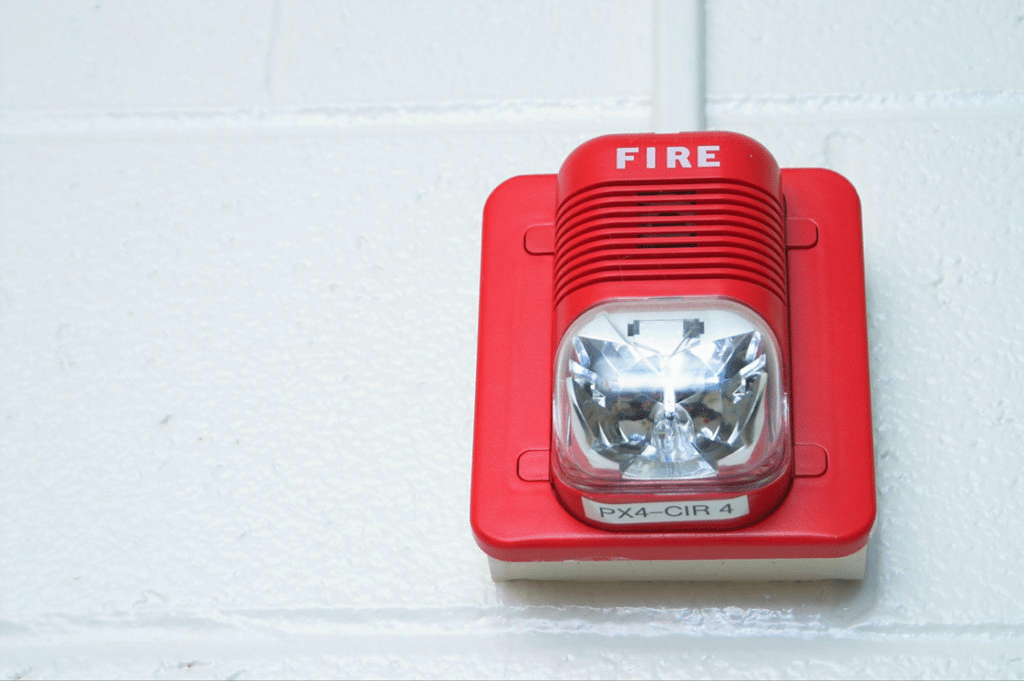
Strobes, as a means of visual notification, are a critical part of fire alarm systems. But when more than one strobe is visible at the same time, NFPA 72 requires that they be synchronized. Strobes flashing out of sync with one another can trigger epileptic seizures, which is why the codes and standards treat synchronization as a serious requirement, not a minor detail.
Why It’s Tricky
Synchronization problems most commonly arise in large facilities — hotels, convention centers, hospitals, large office buildings — where multiple booster power supplies feed different circuits. Strobes on one circuit may flash at a slightly different rate than strobes on another, and where those circuits overlap, occupants will see out of sync strobes.
It’s not always a design oversight. Sometimes it’s simply that no one thought through the circuit layout with synchronization in mind. In facilities that use multiple strobe colors for different alert types the problem can compound further, with different colored strobes flashing at different rates in the same space.
What Can Be Done
During the design phase, careful review of circuit paths and device placements can identify potential synchronization conflicts before installation. During acceptance testing, a physical walkthrough of the building with the alarm activated is the most straightforward way to verify compliance.
When synchronization issues are found post-installation, strobe sync modules are typically the starting point, though solutions vary depending on the system and the manufacturer.
4. Low-Frequency Alarms in Residential Settings: A Newer Requirement Many Systems Are Missing
Research has shown that lower frequency alarm tones (around 520hz) are better at rousing sleeping occupants than high frequency tones. In response, newer editions of NFPA 72 introduced a requirement for low-frequency sounders in residential sleeping areas.
Why It’s Tricky
The challenge is largely a market and awareness problem. For multifamily residential buildings where the code allows the use of individual smoke alarms rather than a full fire alarm system, meeting the low-frequency requirement is difficult. Currently, only one smoke alarm on the market — the Gentex PLACE device — meets the requirement as a standalone unit. Every other path to compliance requires system-type smoke detectors with sounder bases, which are significantly more expensive.
This creates a real-world problem during the bidding process. A contractor using standard smoke alarms will submit a far lower bid than one specifying compliant low-frequency devices, and the difference in cost can be substantial. The result is that the requirement gets overlooked because the technician doing the layout wasn’t trained on the newer standard or wasn’t aware it had been adopted in their state.
What Can Be Done
Awareness is the starting point. Design technicians working on multifamily residential projects need to know which edition of NFPA 72 their state has adopted and what low-frequency requirements apply. This is especially important in states that have recently transitioned to a newer edition of the standard. For building owners and developers, the question to ask during the design phase is simple: does this system meet the low-frequency sounder requirements for residential sleeping areas? Getting that answer early avoids costly corrections during acceptance testing, and ensures that the people sleeping in those units have the best possible chance of waking up in an emergency.
The Bottom Line
As Hopkins puts it, the issues outlined here are ones that are “very subtle, overlooked a lot, and could have dire consequences if ignored.” Fire protection compliance is rarely black and white, and the violations that cause the most damage are often the ones nobody saw coming.
At Summit Fire Security, that depth of knowledge is what we bring to every project, whether it’s a drawing review, a construction walkthrough, an NFPA 25 inspection, or an independent facility assessment. If you have questions about your fire protection systems or want to talk through a specific concern, we’d love to hear from you.