Overview
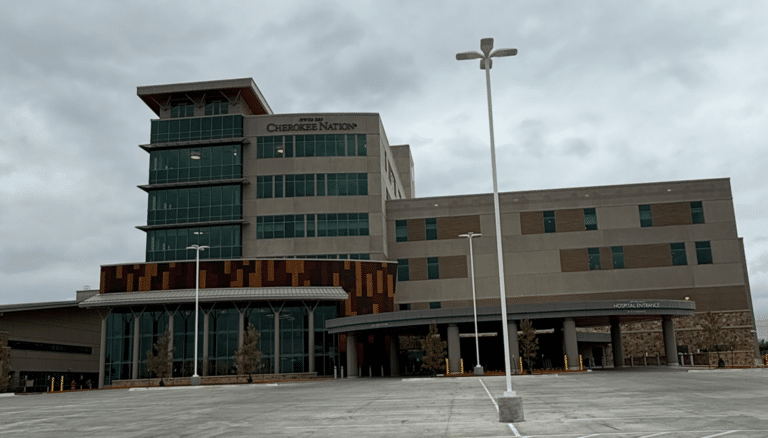
In 2023, Cherokee Nation broke ground on a new $400 million flagship hospital, the largest ongoing construction project in the state of Oklahoma. For Summit Fire & Security, winning the contract six months after the other trades had started meant designing and installing a full fire suppression system for a complex healthcare facility on a tight timeline. Not only did we succeed in protecting everything from server rooms to a rooftop helipad in a challenging regulatory environment, but we also managed to wrap the project up ahead of schedule.
About the Client
Cherokee Nation Health Services (CNHS) is the largest tribally-operated healthcare system in the United States. Headquartered in Tahlequah, Oklahoma, CNHS operates nine tribal health centers, an employee health center, and a tribal hospital, serving over 100,000 patients across northeast and eastern Oklahoma. Nearly 160 full-time providers and more than 2,200 employees deliver not only direct clinical care but a wide range of community health programs, from behavioral health and diabetes prevention to emergency medical services and cancer prevention.
At the center of that system is W.W. Hastings Hospital. In April 2023, Cherokee Nation broke ground on a new six-story, 400,000-square-foot replacement facility designed to serve as a Level 1 trauma center and regional storm shelter. The hospital houses 127 inpatient beds, a full emergency and trauma center, a neonatal ICU, a surgery center, hospice care, and a rooftop helipad.
The Challenge
We first connected to the project through the general contractor, who reached out to us and another firm for bids. But when the competitor withdrew from the bidding process, it created a delay. By the time we had an agreement with the contractor, we were approximately six months behind the other mechanical, electrical, plumbing, and sprinkler (MEPS) contractors.
That delay had immediate consequences. On a project of this scale, there is typically a Building Information Modeling (BIM) coordination process — a digital environment where every subcontractor models their systems, then works together to resolve conflicts before a single pipe or duct goes in. By the time we joined, the other trades had already completed BIM coordination for the first two floors. Without any input on these floors, we would have to design around whatever space was left.
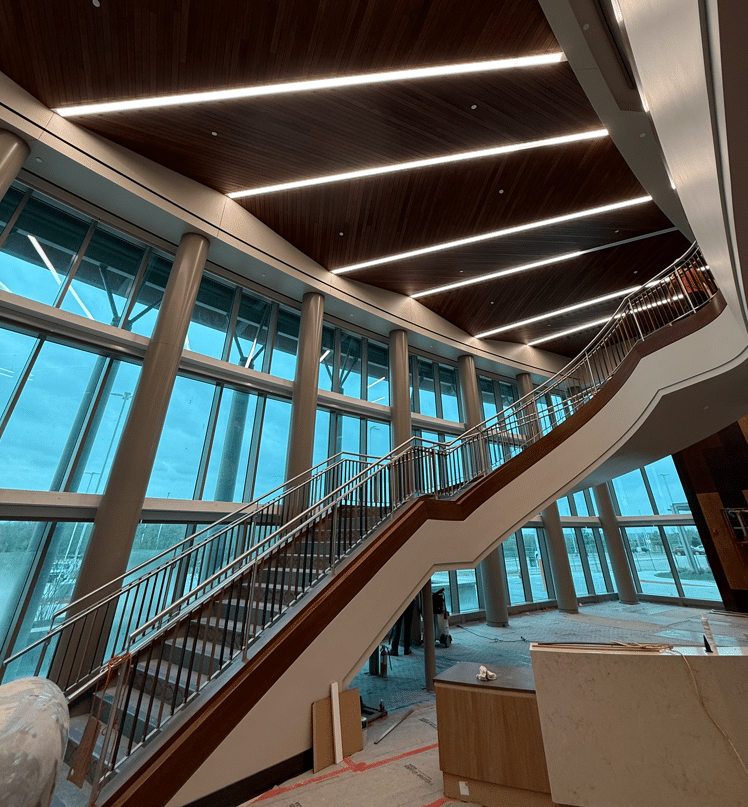
The construction sequence added another layer of complexity. Rather than building floor by floor, the hospital was constructed in five steel sequences that each contained portions of multiple floors. The first sequence, for instance, encompassed parts of the first four floors. That meant our crew was installing incomplete, partial systems from day one, pieces of a puzzle that would only come together once the next section went up. Every material order, every pipe run, every low-point drain had to be planned with that reality in mind.
And then there was the environment itself. Hospitals are among the most demanding fire suppression environments in the industry, thanks to the sheer variety of specialized systems required and the density of what’s packed above the ceilings. Oxygen lines, medical gas, heavy MRI equipment, and structural steel all compete for the same limited real estate as the sprinkler pipe. The hospital was also designed with high ceilings to create a better patient experience, which only compresses that overhead space further.
This project also carried additional layers of regulatory burden on top of those inherent challenges. The facility had to satisfy local fire codes and healthcare accreditation standards. Because the project is a joint venture with the Indian Health Service, a federal agency, it also had to meet IHS building and safety standards, adding a layer of federal requirements on top of local codes. And because hospitals are classified as critical facilities under building code, they are held to a higher seismic design standard than other structures. In this case, that meant a Seismic Zone C designation, requiring lateral and longitudinal seismic restraints on the sprinkler systems throughout.
The Solution
For the first two floors, where the other trades had already claimed their space, our designers drew on years of experience to model our systems around what was already there — adding elbows, rerouting runs, and making do with the space that remained. Thanks to our deep expertise in fire suppression system design, we were fully caught up by the time the third floor was being coordinated, back in the standard rhythm of the BIM process.
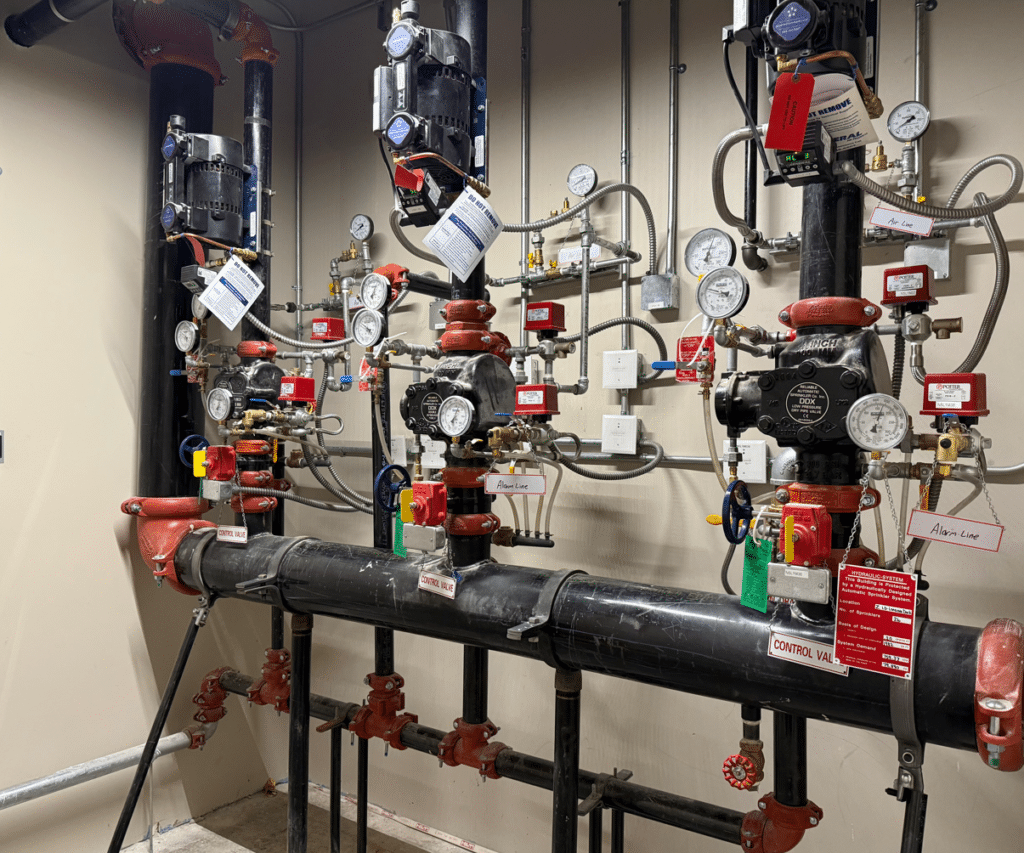
The phased steel sequence presented a different kind of challenge: organizational discipline. With the building going up in sections rather than floors, our crew was always working on multiple partial systems simultaneously, installing pipe that had to be pitched precisely back to drains, tracking what was in storage, and planning orders carefully to avoid either shortages or excess. Every connection point had to be right. When the next section of steel went up, there would be no going back.
Once the full steel structure was in place, we shifted strategy. Rather than working from the ground up, we started on the sixth floor and worked down, a deliberate choice to get pipe and materials to the top of the building while the external hoist was still operational, and to minimize foot traffic damage to completed lower floors. On floors six, five, and four, our crew was often the only trade in the building. Thanks to our efficiency, we managed to finish two months ahead of schedule.
The Results
The full scope of what we designed and installed reflects the complexity of the facility:
- Fire Pump — City water pressure alone isn’t enough for a six-story hospital. Every floor of elevation and every foot of pipe adds friction and reduces pressure. Our fire pump is sized to deliver full pressure to every system in the facility, from the ground floor all the way up to the foam deluge system on the rooftop helipad.
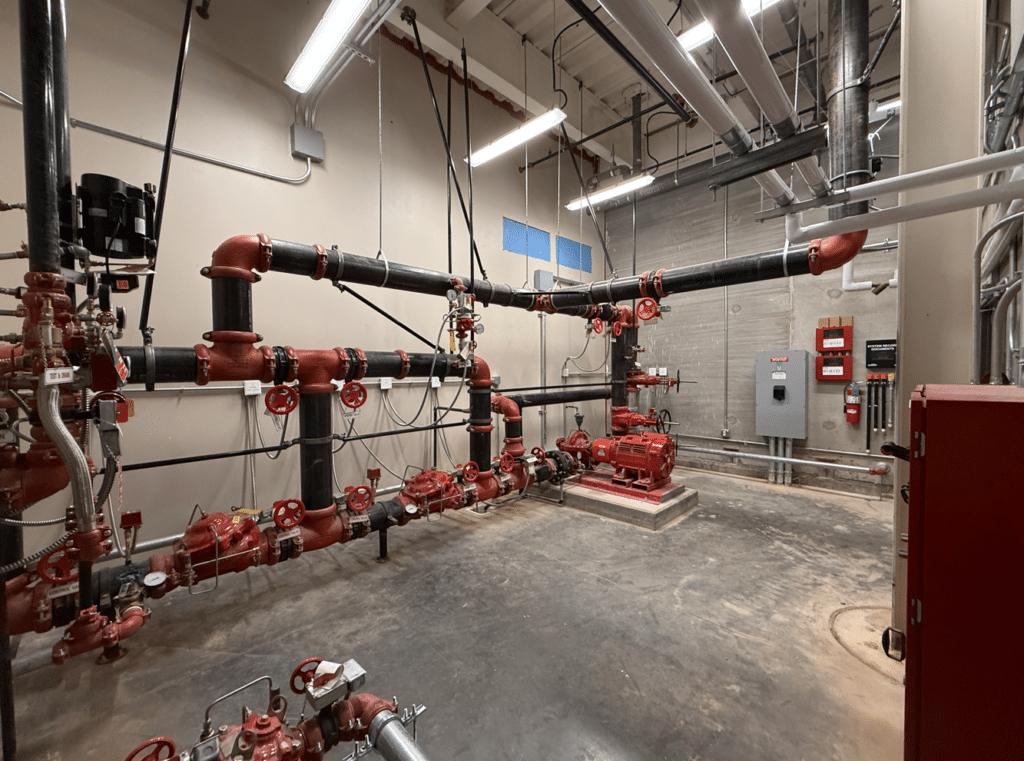
- Automatic Standpipe System — Five 8-inch standpipes with 34 fire hose valves distributed throughout the building, giving the fire department immediate access to water on every floor.
- 155 Fire Extinguishers — We installed extinguishers throughout the facility, as well as the fire-rated cabinets that house them.
- 29 Wet Systems — Conventional wet-pipe sprinkler systems covering hallways, common areas, patient rooms, and other interior spaces throughout the facility.
- 2 Dry Systems — Dry-pipe systems for the loading dock, ambulance bay, and other exterior or cold-exposed areas where standing water in the pipes would freeze. Every pipe in the dry systems had to be precisely pitched back to drain points to ensure water drains completely after each use.
- Backflow-testing — We performed the backflow-testing for our backflow preventer and 14 of the backflow preventers installed by the HVAC/Plumbing contractor.
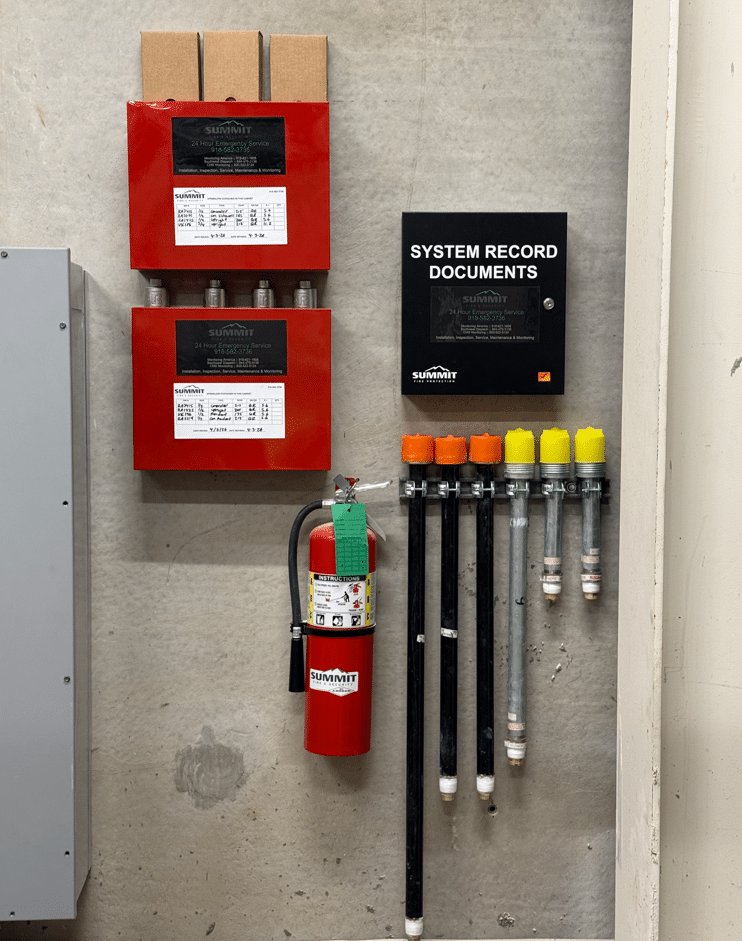
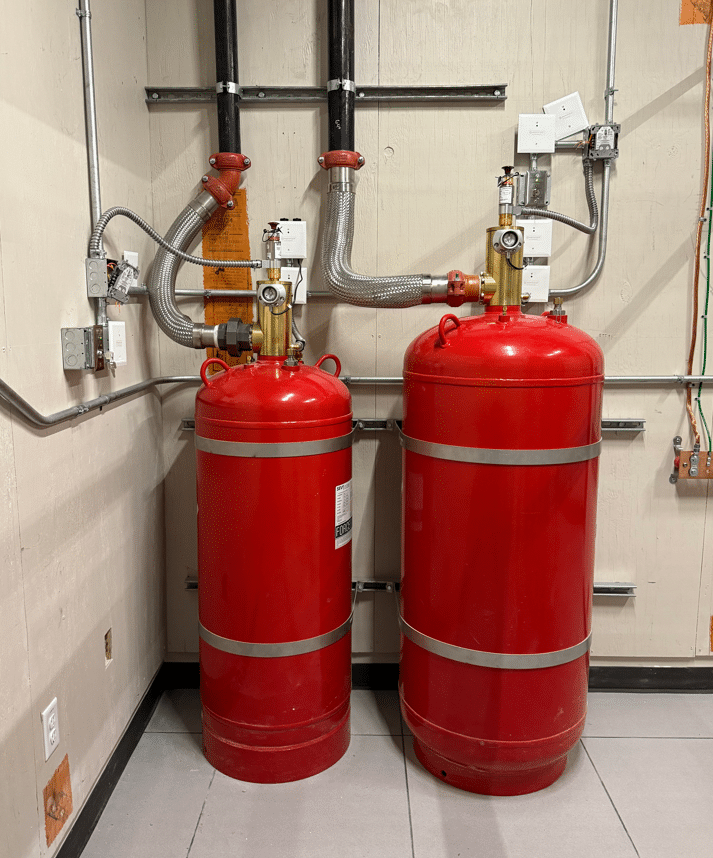
- Clean Agent Preaction Systems, with Double-Interlock Water Backup — The hospital’s server rooms, main power rooms, and UPS equipment called for a very high activation threshold and a suppression agent that wouldn’t damage sensitive electronics. Both systems are pre-action, requiring heat and smoke signals to activate. The clean agent fires first, releasing a pressurized gas that cools and smothers the fire without harming equipment. If that fails and a sprinkler head also activates, the double-interlock water system engages as a last resort, meeting the building’s full-sprinkler requirement without risking water damage unless absolutely necessary.
- Foam Deluge System — The rooftop helipad required a foam deluge system capable of suppressing a jet fuel fire. Eight nozzles mounted beneath the helipad structure discharge foam at a precise angle from all sides, triggered by yellow pull stations positioned at the helipad, the elevator landing, and each point of roof access. The system operates at 145 psi — the highest pressure application in the building, at the furthest point from the pump, requiring us to engineer and brace every component of the system to handle that force when it operates.
The relationship with the Cherokee Nation didn’t end at completion. Midway through construction, Cherokee Nation Healthcare Services was so impressed with our professionalism and execution that they signed a five-year service and inspection agreement covering three additional medical facilities. We now hold service agreements for fire sprinkler, fire alarm, kitchen hood, and backflow certification across four Cherokee Nation facilities, with annual and quarterly inspections beginning this summer.
What started as a race to catch up became a demonstration of what we do best: complex systems, demanding environments, and the organizational discipline to get ahead and stay there.
Do you have a fire protection or life safety project that requires deep local expertise and extensive experience navigating the ever-changing regulatory landscape? Summit can design and install your facility’s fire protection systems, no matter how complex. Find a Summit Fire & Security team near you.