
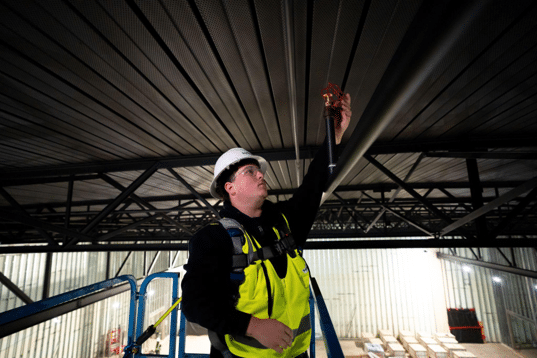
Most building owners know they have fire sprinklers. Far fewer understand what those sprinklers are actually designed to do or how they do it. That gap matters more than it might seem, because a misunderstood system is an easy one to neglect, and a neglected system may not perform when it counts.
This post covers how sprinkler systems work, what they’re built to accomplish, and what keeps them ready for when they’re needed.
Four types of sprinkler systems
There are four main types of sprinklers, each suited to a distinct set of conditions.
- Wet pipe systems: Water is in the pipes under pressure at all times; when a head triggers, water flows immediately. Wet systems are the most common type and are the standard choice for most commercial and residential buildings.
- Dry pipe systems: Dry systems fill the pipes with pressurized air or nitrogen instead. When a head triggers, that pressure drops and a valve releases water into the pipes. These systems are used in unheated spaces, especially in regions like the Northeast with harsh winters.
- Pre-action systems: These require two independent events before water is released, typically a smoke or heat detector activating in addition to a sprinkler head triggering. The added threshold makes them the standard for data centers, server rooms, and other environments where an unintended discharge would cause as much damage as the fire itself.
- Deluge systems: Deluge heads don’t have heat-activated bulbs. When the system is triggered by a separate heat or smoke detector, water or a fire suppression agent is released to all heads simultaneously. These are reserved for high-hazard settings: aircraft hangars, chemical storage facilities, and fueling stations.
How wet and dry systems work
Wet and dry systems account for the majority of commercial and residential installations nationwide, so it’s worth understanding how they work.
Each sprinkler head contains a small glass bulb filled with a glycerin-based liquid. As heat from a fire rises to the ceiling, that liquid expands until the pressure shatters the bulb. From there, the two system types diverge. In a wet system, water is already waiting in the pipes and flows immediately once the bulb breaks. In a dry system, the bulb shattering causes air pressure to drop in the pipes, which signals a valve to open and send water through.
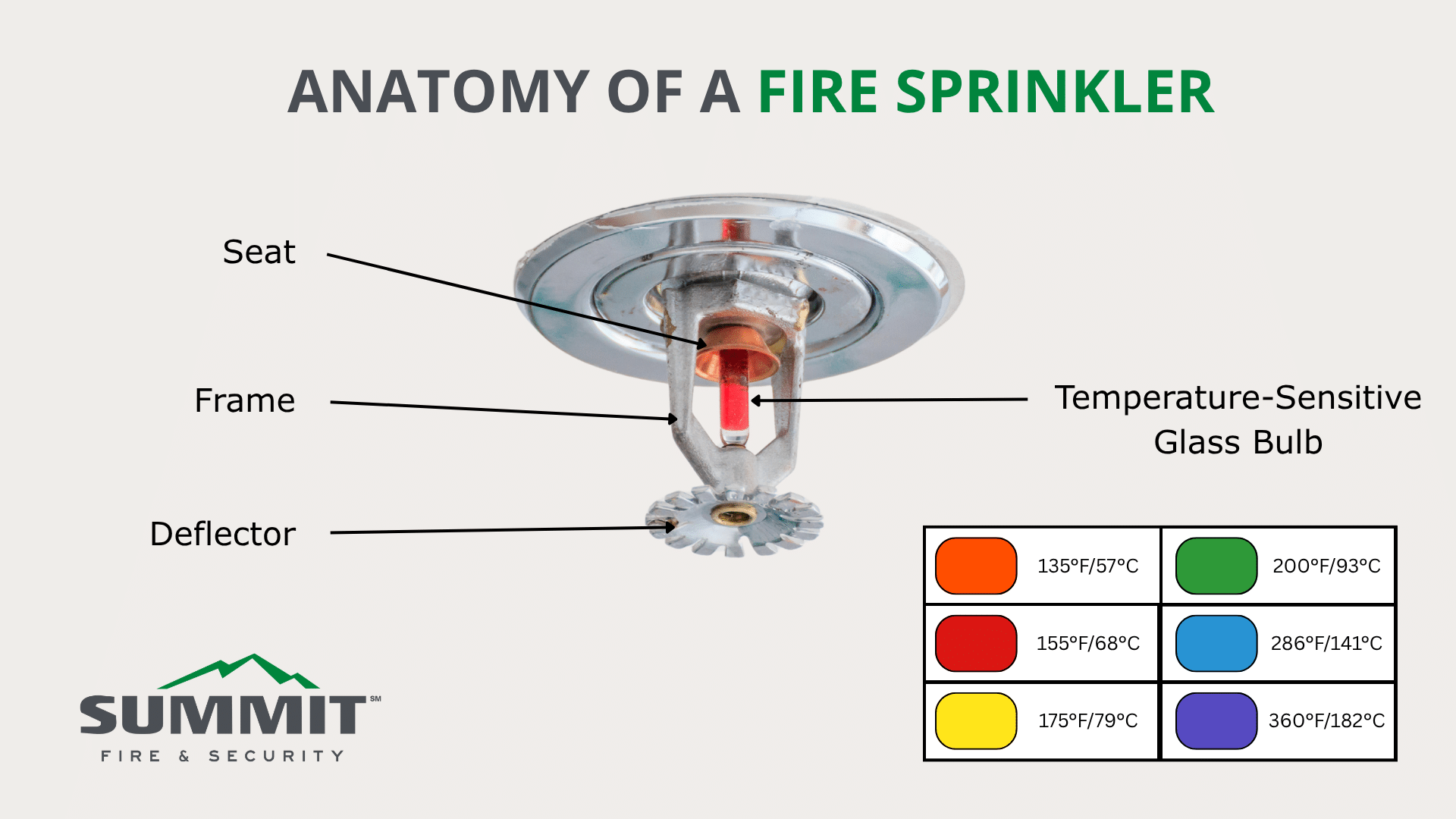
In both cases, water hits a deflector plate and sprays outward in a pattern sized to cover the area below.
What makes one sprinkler head different from another
From across a room, most sprinkler heads look alike. They aren’t. Two variables matter most when a system is being designed.
- Bulb color. The color of the liquid inside indicates the activation temperature: red bulbs are rated at 155°F, while yellow, green, and blue bulbs are calibrated for environments that run naturally hotter. Bulb diameter affects speed: a 3mm bulb is classified as quick response, while thicker 5mm and 7mm bulbs activate more slowly and are used in standard response applications.
- Orifice size. The opening where the head connects to the pipe, known as the orifice, determines how much water flows through when the head is triggered. Higher-hazard occupancies require larger orifices and greater water delivery volumes. A head sized for a suburban office building isn’t appropriate for a high-piled storage facility or an industrial processing environment.
On the West Coast, system design carries an additional layer of complexity. In seismic zones across California and the Pacific Northwest, sprinkler systems are required to include lateral and longitudinal restraints to keep pipe runs from shifting or failing during an earthquake.
Control vs extinguish
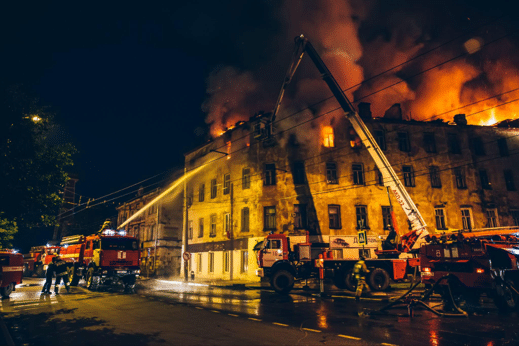
The assumption most people make is that a sprinkler system will put a fire out. They can do that, but it’s important to understand that isn’t their primary purpose.
The fire protection industry uses four terms to describe what a suppression system can do to a fire:
- Control (holding the heat release rate steady and preventing growth)
- Suppress (actively reducing the fire’s intensity)
- Confine (keeping it from spreading beyond a defined area)
- Extinguish (putting it out entirely).
Standard sprinkler systems — the kind found in most commercial and residential buildings — are designed and code-tested against the benchmark of control. The primary job is to protect occupants long enough to evacuate safely and prevent the fire from spreading until the fire department arrives. Extinguishment is the fire department’s responsibility.
In practice, sprinklers often do more than that. Many fires are fully out before firefighters arrive. But a system that activates, keeps a fire confined to one room, and buys ten minutes of safe evacuation time has done exactly what it was designed to do.
How effective are sprinklers?
When measured against their actual design purpose, sprinkler systems perform exceptionally well. According to NFPA data covering 2017 to 2021, sprinklers operated in 92% of fires large enough to trigger them and were effective at controlling the fire in 97% of those cases.
But the truly striking figure is when you look at the actual impact of sprinklers: the civilian injury rate per 1,000 reported fires is 90% lower in buildings with sprinklers than in those without, according to NFPA data. Not only do sprinkler systems do a good job at controlling fires, they actively save lives.
That being said, it’s worth noting that there are still instances when sprinkler systems don’t do what they’re supposed to. Let’s take a look at why.
Why systems fail
NFPA data points to a consistent finding: when sprinkler systems fail to operate, the cause is almost never a mechanical defect. It’s human error in design, installation, maintenance, or operation. Three patterns account for the vast majority of failures:
- The most common, by a wide margin, is a system that was simply turned off. This accounts for 63% of all failures. A valve is closed during a maintenance visit and never reopened. A monitoring alarm gets silenced without anyone investigating the cause. With the water supply cut off, a functional system can’t do anything when it’s needed.
- The next is deferred maintenance. Sprinkler systems require regular attention. Corrosion builds up over time, a heightened concern in high-humidity coastal environments, where metal components face greater environmental stress. Over time, heads might get painted over, components can degrade, and pipes may fill with sludge, but unless an inspector is finding and addressing problems on a regular basis, maintenance issues are likely to remain invisible.
- The third is a system that wasn’t designed correctly for its environment. A system specified for a standard office occupancy isn’t suitable for a cold storage warehouse or a high-rack distribution center. Fire hazards vary dramatically by building type and use, and the system requirements vary along with them. Getting the design right from the start is what makes everything downstream work.
Performance doesn’t happen on its own
Fire sprinklers are one of the most effective tools available for protecting buildings and the people inside them. They do what they’re designed to do with remarkable consistency: buying time, protecting lives, and preventing contained incidents from becoming catastrophes.
But that performance isn’t automatic. It requires the right system for the environment, correctly installed, maintained on schedule, and monitored properly. Cut corners on any one of those and the numbers stop working in your favor.
Summit Fire and Security has extensive experience designing, installing, inspecting, and maintaining sprinkler systems of all types across a wide range of building types, climates, and code environments. Whether you’re building new, bringing an older system up to current standards, or making sure what you have is ready when it matters, our team is here to help.
Reach out today to connect with a Summit Fire and Security branch near you.